Most organizations know delivery feels slower than it should. Fewer can explain exactly where the time goes.
A request enters the system. A strategic initiative gets approved. A regulatory change becomes urgent. Then the work moves through intake, prioritization, analysis, funding, architecture, delivery, testing, security, release, training, adoption, and support.
Somewhere in that chain, time disappears.
Teams are busy. Status reports are full. Meetings are happening. But leaders still struggle with the questions that actually matter:
- Where is work waiting?
- Where does rework enter the system?
- Which handoffs create the most delay?
- Which decisions sit too long?
- Where are improvement dollars being spent without changing the real constraint?
That is why Value Stream Mapping matters.
It shows the path work takes from initial need to delivered value. More importantly, it helps leaders stop treating delivery as a collection of disconnected teams and start seeing the system those teams are working inside.
Value Stream Mapping is not just process documentation
Many companies already have process maps, org charts, workflow boards, and project plans. Those can be useful. They just do not always answer the right question.
A process map usually shows the steps people believe work follows.
A value stream map asks something sharper: what does the work experience as it moves through the organization?
That difference matters. A value stream map shows flow, delay, queues, handoffs, rework, decision points, ownership gaps, and outcomes. It often reveals that the biggest constraint is not where leaders expected it to be.
The slowest part may not be coding, configuration, testing, or training. It may be intake, funding, approval, dependency resolution, waiting for a shared expert, unclear ownership, or too much work in progress.
That can be uncomfortable. Good. The purpose of the map is not to make the system look clean. It is to make the system visible.
What leaders should get from a value stream map
A useful VSM effort should produce more than a diagram. If the output is only a polished picture for a slide deck, the work stopped too early.
Leaders should come away with:
- A current-state view of how work actually moves from request to outcome
- A clear hypothesis about the system constraint
- Baseline measures for flow time, wait time, rework, throughput, quality, or predictability
- A small set of improvement experiments
- Clear owners for those experiments
- A cadence for checking whether the system changed
That is the practical value. The map creates visibility. Measurement creates context. Experiments create movement.
The real value is seeing work as a system
Enterprise work rarely moves through one team from start to finish. It crosses functions, leaders, vendors, tools, governance forums, compliance checkpoints, and support models.
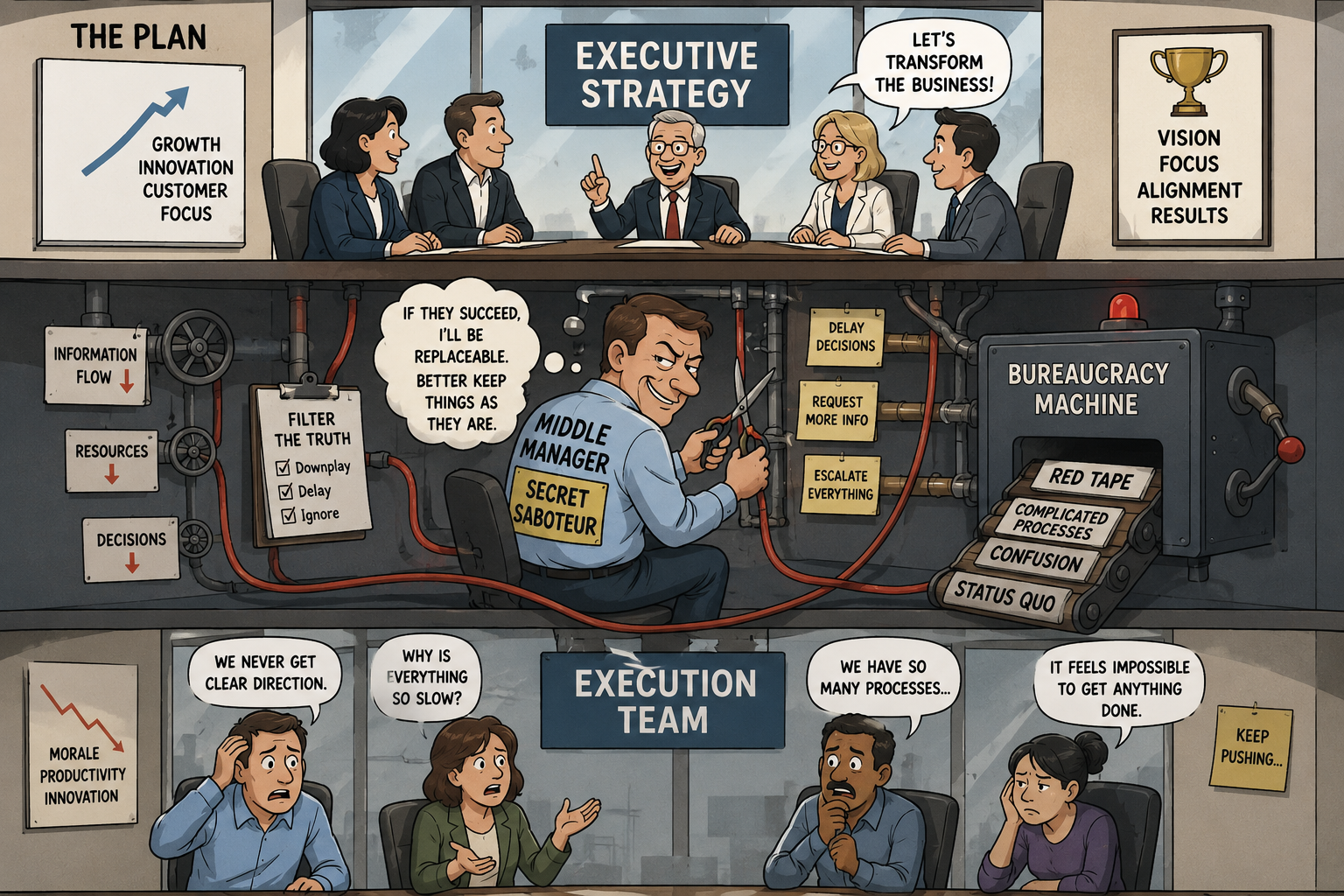
When each group optimizes only its own lane, the full system can still get slower.
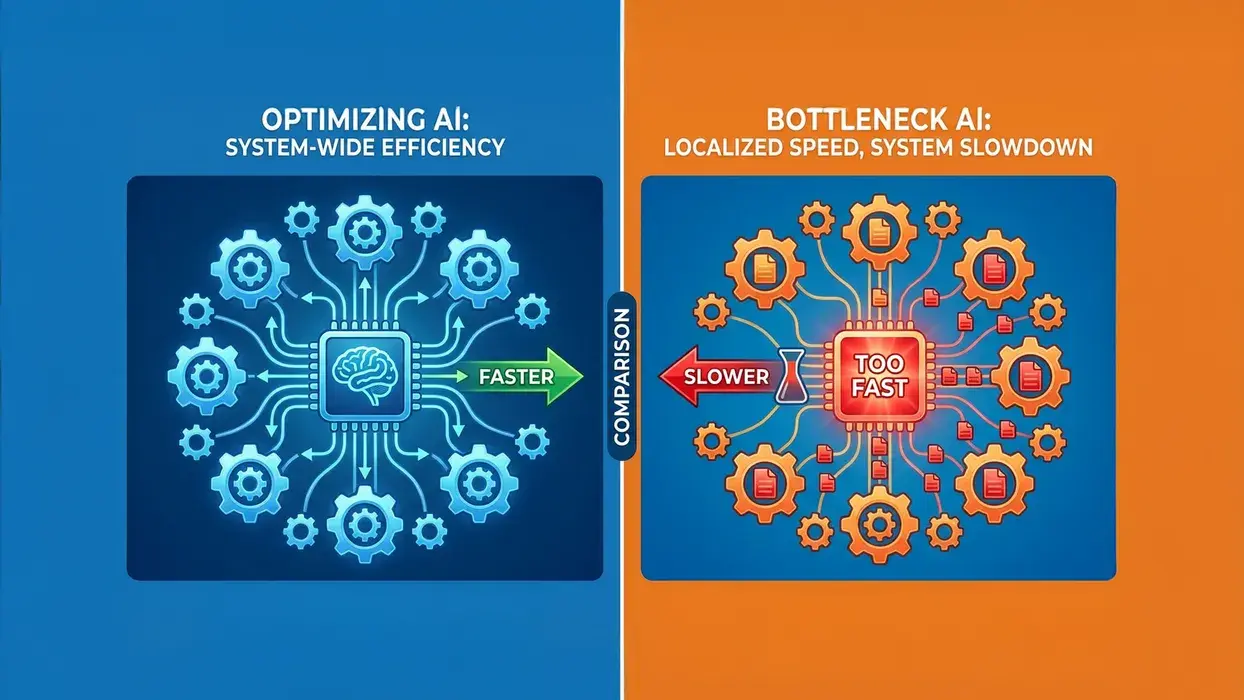
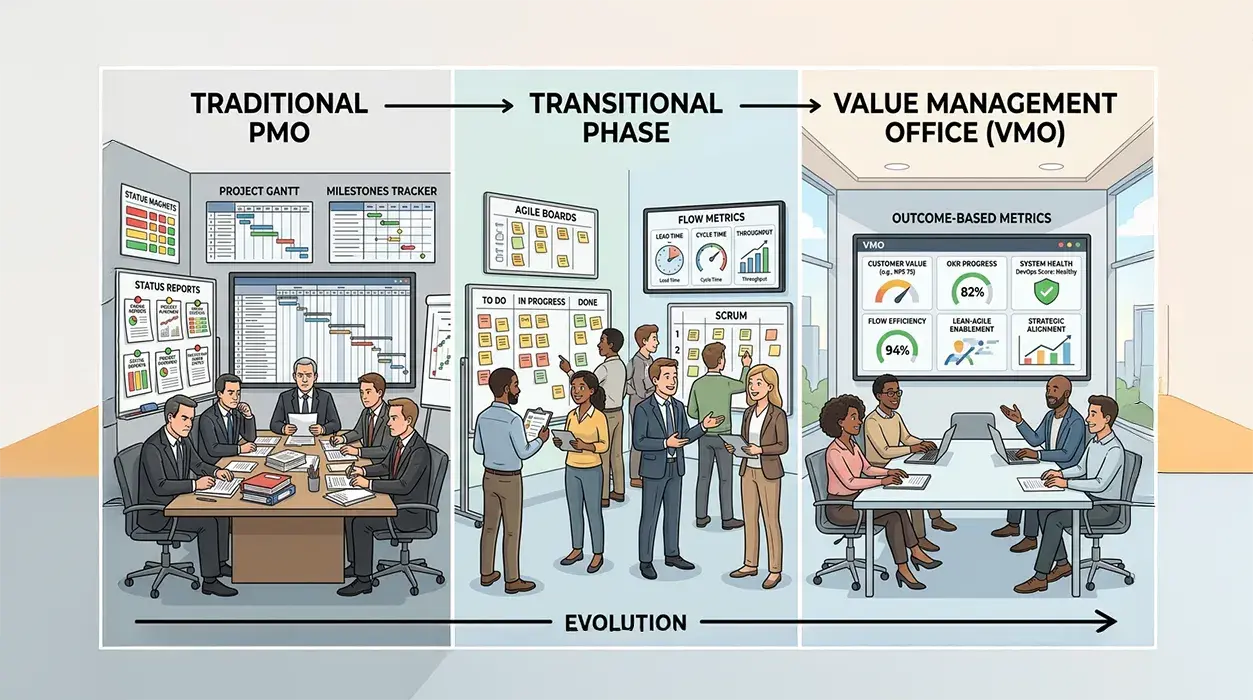
One team improves its sprint discipline, but work still waits for prioritization. Another team automates deployment, but releases still bottleneck in approval. A PMO improves status reporting, but leaders still cannot tell whether business outcomes are moving. A technology group adds AI to a workflow, but the real constraint was never task execution. It was decision latency.
VSM exposes those disconnects.
It brings the right people into the same conversation and gives them a shared view of the current state: how work enters, how it is understood, where it waits, how it changes, where it gets blocked, and how value is eventually confirmed.
That system view is especially important in enterprise and regulated environments. The goal is not to remove every control. Some controls protect quality, safety, risk posture, and customer outcomes. The better goal is to understand which controls are doing useful work and which steps are adding delay without improving the result.
Measurement creates the context for improvement
A good map should not stop at sticky notes on a wall. The map creates visibility. Measurement creates context.
Useful value stream measures often include flow time, wait time, rework, throughput, work in process, predictability, quality, and outcome measures tied to the business, customer, operational, risk, or employee result the work was supposed to change.
The exact measures depend on the value stream. A clinical workflow, infrastructure backlog, product delivery system, onboarding journey, and compliance change process will not all use the same dashboard.
But the leadership discipline is the same: measure enough of the system to understand where improvement should focus.
Without measurement, improvement becomes opinion-driven. The loudest pain gets attention. The most visible team gets pressure. The newest tool gets blamed. The easiest local fix gets funded.
With measurement, leaders can see whether the biggest delay is in intake, analysis, dependency management, testing, approval, deployment, adoption, or feedback. They can separate a team performance issue from a system design issue. That distinction is everything.
Measurement also proves whether the change helped
This may be the most important reason to map and measure the value stream.
Organizations spend enormous energy on new tools, ceremonies, operating models, automation, AI pilots, training, governance changes, and modernization programs. Too often, they judge success by whether the change was implemented.
That is not enough.
The better question is whether the system improved.
If a team introduces a new intake model, did decision aging improve? If a group changes its testing approach, did rework decrease? If leadership creates a dependency forum, did blocked time go down? If automation is added to a workflow, did total flow time improve, or did the work simply move faster into the next queue?
That last question matters for AI and modernization.
Automation helps when the constraint is repetitive manual effort. It disappoints when the real constraint is unclear priority, overloaded shared resources, slow approvals, weak data quality, unresolved ownership, or too much work entering the system at once.
Value Stream Mapping helps leaders avoid modernizing the wrong problem.
The output should be improvement experiments
A value stream map is only useful if it leads to action.
The goal is not a beautiful artifact. The goal is to identify the few improvement experiments most likely to change the system.
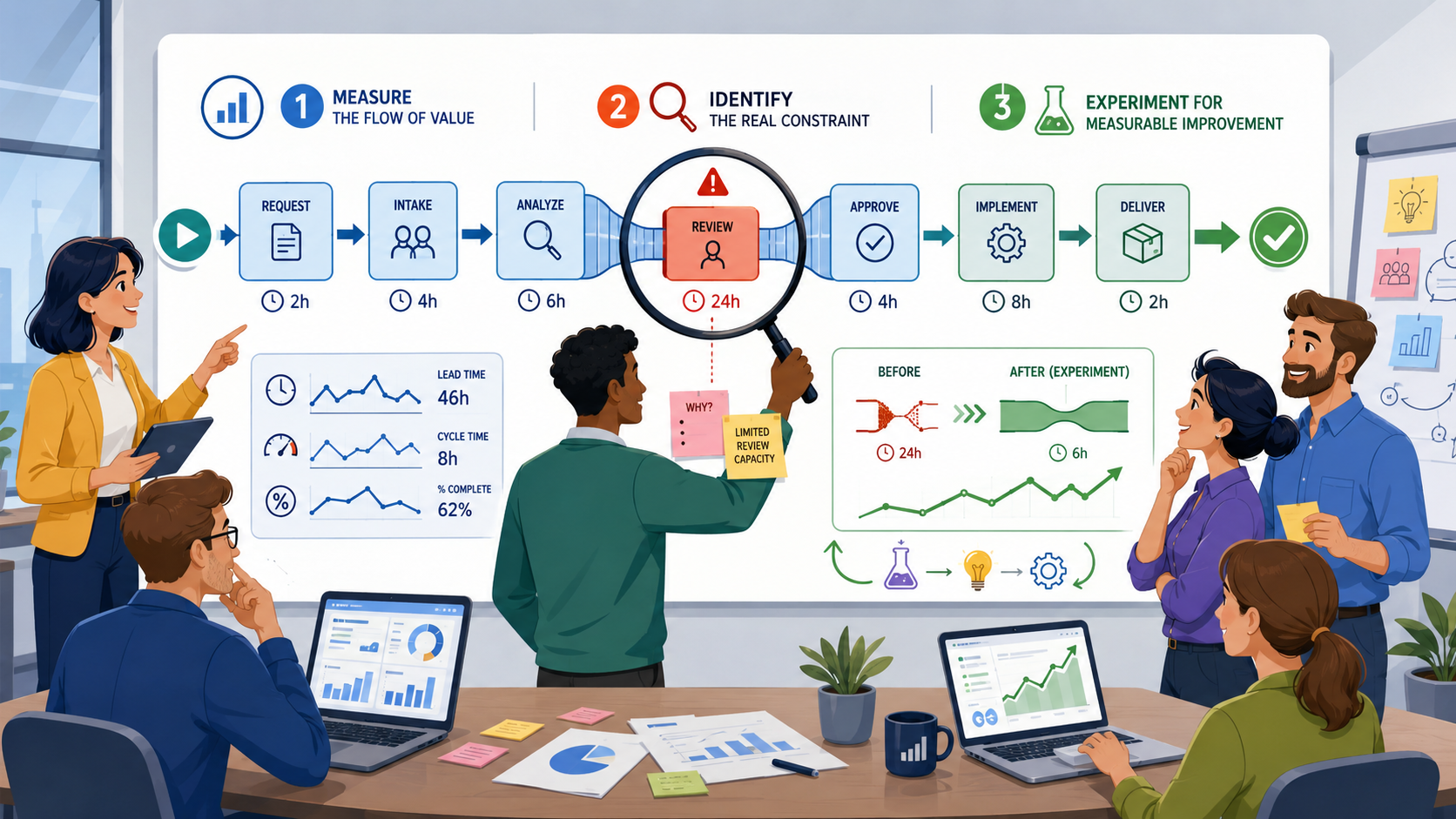
A strong VSM effort follows a simple discipline:
- Map the current state.
- Measure the flow.
- Identify the most important constraint.
- Run a focused improvement experiment.
- Inspect whether the measure changed.
- Decide what to keep, change, stop, or try next.
This keeps improvement grounded. It also prevents the familiar pattern where organizations generate a long list of pain points, agree that “communication” needs work, and then return to the same habits.
The most useful improvement is often narrower than leaders expect: reduce one recurring queue, clarify one ownership boundary, set one WIP limit, change one approval policy, create one dependency rule, or make one handoff measurable.
Small changes matter when they are aimed at the real constraint.
The leadership question
Value Stream Mapping gives executives, transformation leaders, PMO leaders, operations leaders, technology leaders, and teams preparing for automation or AI-enabled workflow changes a way to replace vague frustration with practical visibility.
It shows how work really moves. It exposes delay and rework. It creates the measurement context needed to choose better improvements. And it gives the organization a way to prove whether those improvements helped.
For companies trying to improve delivery, modernize operations, or apply AI intelligently, this is foundational work.
Do not start by asking which tool, ceremony, or automation will make people faster.
Start by asking: where does value actually get stuck?
That is the conversation Value Stream Mapping is built to create.
If your organization is investing in transformation, modernization, or AI but still cannot clearly explain where delivery gets stuck, start with the value stream. Alacient helps leaders map how work really moves, identify the constraint that matters most, and design measurable improvement experiments.
← All insights